
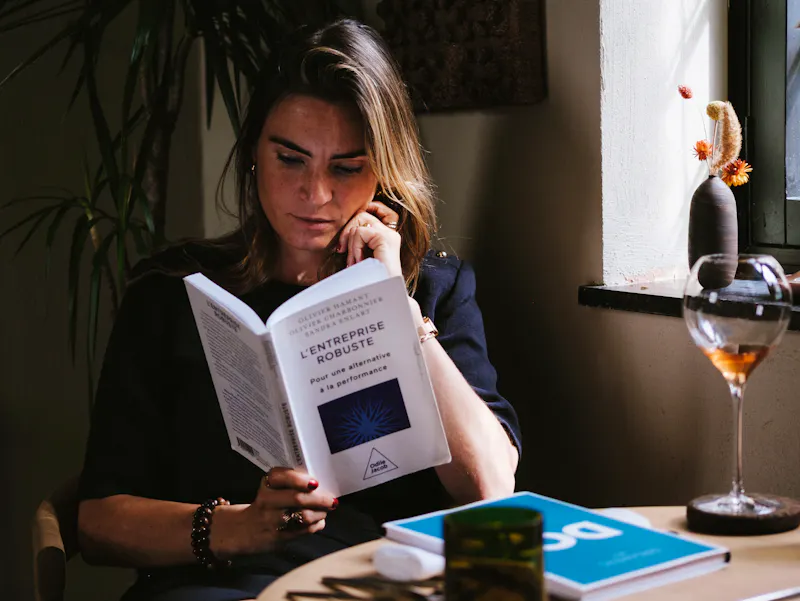
Entropy & Hearth Project in Olivier Hamant's The Robust Company
Entropy & Hearth Project in Olivier Hamant's L'Entreprise robuste
Featured in Olivier Hamant's book, Entropy and Hearth Project showcase a different way of doing business, built on resilience, cooperation and sustainability.
What if business success were measured not only by efficiency, growth and profitability, but also by the ability to endure, adapt and contribute positively to the world around us?
This question lies at the heart of L'Entreprise robuste, a book by French biologist and researcher Olivier Hamant, in which Entropy Restaurant and our non-profit organisation Hearth Project, both based in Brussels, are mentioned.
This recognition means a great deal to us. It reflects a belief that has guided our journey from the very beginning: rather than pursuing constant optimisation, we want to build a model rooted in cooperation, diversity, local connections and resilience.
From performance to robustness: redefining success
For decades, businesses have been encouraged to optimise their resources, processes and profitability. Produce more with less. Reduce inefficiencies. Eliminate unnecessary costs.
While this pursuit of performance has brought progress, it has also created systems that can be remarkably fragile, dependent on complex supply chains, limited resources and stable economic conditions.
Through his research on living systems, Olivier Hamant invites us to reconsider this approach.
In nature, the organisms best equipped to survive are not necessarily those performing at their maximum capacity at every moment. They often rely on diversity, redundancy, adaptability and cooperation to withstand disruption.
Robustness is therefore not about achieving the highest possible performance under ideal conditions. It is about remaining viable when circumstances change.
This distinction is particularly relevant to the hospitality industry, where rising costs, unpredictable supply chains, pressure on teams and changing consumer habits constantly challenge established business models.
Entropy Restaurant: gastronomy shaped by its ecosystem
Since its creation in Brussels, Entropy has developed a 100% plant-based gastronomic approach built around local, seasonal ingredients and circular practices.
Our cuisine is shaped by collaborations with more than 45 local producers and artisans, whose harvests, knowledge and agricultural realities influence the menus we create.
In a conventional performance-driven model, a restaurant might seek to standardise its supply chain to guarantee the same dishes throughout the year.
We chose a different path.
When harvests change, our cuisine adapts. When an ingredient becomes unavailable, we explore alternatives. When resources risk going to waste, we look for ways to preserve, ferment or transform them.
This flexibility sometimes requires more creativity, time and coordination. Yet it also allows us to develop a deeper understanding of ingredients, seasons and the people behind them.
Rather than working against the constraints of nature, we choose to make them a source of inspiration.
Circularity as a way of operating
Robustness is closely connected to our understanding of circularity.
In natural ecosystems, what one organism leaves behind often becomes a resource for another. Matter circulates, nutrients return to the soil, and living systems continuously regenerate.
At Entropy, this observation inspires the way we work.
We seek to make the most of every ingredient, reduce food waste and develop collaborations that give existing resources new purposes.
Fermentation, preservation, creative transformations and partnerships with local artisans all contribute to this approach.
Our ambition is not to claim that we have achieved a perfectly circular model, but to continually question how resources can be used more thoughtfully.
Sustainability becomes a practical way of organising our activities, rather than simply a statement of intent.
Hearth Project: extending our impact beyond the plate
While Entropy serves as the gastronomic laboratory for this approach, our non-profit organisation Hearth Project extends its social and educational dimensions.
Through Hearth Project, we aim to make sustainable food systems more accessible by connecting gastronomy, social inclusion, education and knowledge sharing.
Transforming our food system cannot depend solely on restaurants or consumers who are already environmentally conscious.
It also requires opportunities for people to meet, learn, experiment and participate.
Educational workshops, collective projects and initiatives exploring our relationship with food are all part of this ambition.
The combination of an economic activity and a non-profit organisation allows us to explore different ways of creating value.
Value that goes beyond revenue and includes the knowledge shared, relationships developed and connections created within a community.
Cooperation instead of complete control
One of the foundations of robustness is the diversity and interdependence of the actors within a system.
For businesses, this means reconsidering what independence really means.
Being robust does not necessarily require producing everything internally or controlling every aspect of an operation. It can also mean developing strong, diverse relationships that make collective adaptation possible.
At Entropy, our network of farmers, producers, artisans, non-profit partners and sustainable food initiatives is an integral part of our model.
These collaborations encourage knowledge sharing, experimentation and a better understanding of each other's challenges.
They also help support independent supply chains and preserve local expertise.
Cooperation is therefore more than a human value. It can become a genuine strategy for economic and territorial resilience.
A robust business is not a business without challenges
It would be tempting to present robustness as the answer to every challenge entrepreneurs face.
The reality is more complex.
Building a business around local sourcing, sustainable practices and meaningful human relationships comes with significant constraints.
Production costs, resource availability, the demands of the hospitality sector and financial viability remain everyday challenges.
Robustness does not eliminate these tensions.
Instead, it encourages us to approach them differently: by diversifying activities, developing new partnerships, embracing experimentation and regularly questioning established habits.
It also means recognising that a business can evolve, change direction or reinvent itself without necessarily abandoning its purpose.
The goal is not to create a business that never changes, but one that can continue to create meaning in a changing world.
Towards a more regenerative economy
Beyond gastronomy, the ideas explored in L'Entreprise robuste invite us to rethink our understanding of the economy itself.
What if businesses were assessed not only by the resources they consume and the financial results they generate, but also by their contribution to the health of the systems they depend on?
In the food industry, this question is particularly tangible.
Without living soils, biodiversity, farmers and artisanal knowledge, sustainable gastronomy simply cannot exist.
Protecting these resources is therefore not a secondary concern. It is a fundamental condition for our long-term viability.
This is the perspective we hope to continue exploring through Entropy and Hearth Project: developing models that combine economic value, social purpose and respect for the living world.
Less performance at all costs. More robustness, connection and purpose.
Seeing Entropy Restaurant and Hearth Project mentioned in Olivier Hamant's book encourages us to continue this journey.
Not because our model is perfect or complete, but because it contributes to an essential conversation about the future of organisations.
How can we build businesses without exhausting the resources they depend on? How can we reconcile economic viability, cooperation and positive impact? How can we create projects that remain meaningful and relevant as the world changes?
We do not have all the answers.
But we believe that tomorrow's businesses will need more diversity, stronger relationships, greater adaptability and a deeper sense of purpose.
And gastronomy, sitting at the crossroads of agriculture, economics, culture and the living world, offers an extraordinary space for experimentation.
Less performance at all costs. More robustness, connection and purpose.
Discover also
Fully Equipped Restaurant & Business for Sale in Central Brussels
Place Saint-Géry, Brussels: fully equipped 165 m² restaurant, €750K turnover, business and lease rights for sale. Takeover from Jan 27, priced bet. €120K -150KEntropy Reopens for 6 Exclusive Plant-Based Fine Dining Evenings!
Entropy returns for 6 exclusive fine dining evenings in Brussels this November and December. Discover our 4-course plant-based menu with pairings for €120.GoodPlanet Partnership: Inspiring Children to Embrace Sustainable Food
Elliott Van de Velde, chef at Entropy, together with his non-profit org. HEARTH PROJECT, introduces children to local and seasonal produce through all 5 senses.Entropy at Manger Mieux Demain: tastings & sustainable food workshops
Tasting, sharing, learning together: a look back at Manger Mieux Demain, where we shared our approach to plant-based cuisine & sustainable foodEvent: Domaine Pierre Frick wines at Entropy’s table
On 23 Oct 2026, living wines from Alsace meet plant-based gastronomy with Nat Or Not and Domaine Pierre Frick. Limited places. Booking required.Manger Mieux Demain: reconnecting with the source of our food
Entropy at Manger Mieux Demain: producers, plant-based cuisine, workshops and encounters to shape a more local and sustainable food system.Why Moby Chose a Plant-Based Restaurant in Brussels
During his visit to Brussels, Moby chose Entropy for dinner. A simple encounter that reflects the values we have shared since day one.Why Hosting Your Event at Entropy Is Unlike Anywhere Else
A historic, sustainable venue in the heart of Brussels for corporate events, private dining, team building, meetings and unforgettable celebrations.Transmission: Building Culture in a Plant-Based Kitchen
Discover how shared knowledge, curiosity, and teamwork shape the culture behind Entropy's plant-based fine dining experience—one service at a time.Every Ending Is a Beginning: Entropy's Next Chapter
We're saying goodbye to daily service and hello to a new way of bringing people together through private events and shared experiences.Plant-Based Proteins: A Source of Culinary Inspiration
When we talk about plant-based proteins, they are often presented as an alternative to meat.Hazelnuts and Walnuts: What Lies Behind the Crunch?
Tree nuts have become essential ingredients in plant-based cooking.Edible Flowers and Aromatic Herbs: Much More Than Decoration
Flavor, texture, volume, freshness, color, and aromatic balance: they have become a true culinary language.Honey: What Role Does It Play in Our Diet?
For many, honey is seen as an alternative to sugar. But if we take a step back, is honey really a sustainable product?100% sourdough: health, sustainability, biodiversity
When time becomes an ingredient, and sourdough redefines the taste of bread.Sustainable Food & Plant-Based Cuisine: The Future of Gastronomy
Why Is the Future of Food Plant-Based?Financing Impact Differently: Looking Back on Our Journey with LITA
When citizen finance becomes a lever for impact.Plant-based cuisine: trend or shift, can it appeal to non-vegetarians?
Does plant-based food appeal to everyone? 70% of Entropy’s guests are not vegetarian: what makes them come back?Plant-Based Gastronomy & Commitment: What Are the Training Challenges
How do you train a team when the dishes change with the seasons?What if the perfect pairing wasn’t found only on the plate?
Rethinking the place of beverages in plant-based gastronomy.Think of Entropy for your sustainable plant-based events.
Entropy caters your events from 20 to 600 guests with sustainable plant-based cuisine, both indoors and outdoors.This sustainability label rewards Entropy Restaurant with the highest
Entropy Restaurant receives the Good Food label’s highest distinction in Brussels for the 4th consecutive year, rewarding its committed sustainable cuisine.A NEW MENU GUIDED BY THE SEASON
A new seasonal menu shaped by harvests, featuring asparagus, mushrooms, flowers, and herbs at their peak.From Producer to Plate
In Brussels, Entropy links cuisine to producers with seasonal menus, short supply chains, and local, sustainable collaborations.“It’s not rocket science in your plate!”
Entropy, with Be Planet and Le Bon Moment, launches a campaign to fund a mobile educational caravan on sustainable food for children in Belgium.Pause between two seasons at Entropy, ahead of the reopening on May 21
At the beginning of May, Entropy is taking a short break to follow the rhythm of the seasons. Reopening on May 21 at the start of summer — we look forward to seEntropy closes its restaurant to build a food innovation incubator
Entropy is temporarily closing its restaurant to launch a European project on sustainable food and build an incubator for future food systems.Entropy among Belgium’s most inspiring restaurants
Entropy is proud to be featured by De Morgen among the most inspiring restaurants in Brussels and Flanders, recognizing our sustainable cuisine.Entropy – Top 25 Most Sustainable Restaurants in Europe – 360 EatGuide
Entropy joins the Top 25 sustainable restaurants in Europe by the 360 Eat Guide, recognising pioneers leading the future of responsible gastronomy.Blending Craft & Activism: Entropy enters Collège Culinaire Belgique
At Entropy, craftsmanship meets activism through seasonal plant-led cuisine, conscious sourcing and in-house work, shaping an agile gastronomy rooted in impact.Entropy Restaurant Ranked #10 in Belgium by the 360° Eat Guide
Entropy Restaurant enters Belgium’s 360° Eat Guide Top 10, a recognition of a plant-forward cuisine driven by consciousness, seasonality, and constant evolutionShaping the Future of Food with Hearth Project & Entropy Restaurant
Proud to be selected among the winners of the EU TASTE call and the City of Brussels Climate Plan, advancing sustainable food innovation and climate action.Entropy: 4 years of sustainable gastronomy, 15 of entrepreneurship
In May, Entropy Restaurant celebrates 4 years in Brussels. A project built over 10 years, with plenty of work behind the scenes to get here.DRY JANUARY: Why we love it and what does it say about you.. and us !
Dry January at Entropy is all year round. When alcohol takes a step back: a simple passing trend, or a genuine shift toward preventive health awareness?Elliott Van de Velde, named amongst 50 personalities of tomorrow (BE)
Elliott Van de Velde, among the talents shaping the food systems of tomorrow, according to Trends/Tendances’ 2026 ranking of Tomorrow’s Personalities.Exchange with Andrea Mastropietro, gardener at Piazza Duomo***, Alba.
In Belgium, Andrea Mastropietro and Dries Delanote shared insights on soil, gardeners, and their essential role in a living, plant-based cuisine.For the 5th year, alongside the Green Santa of Secours Populaire.
A collective effort with local partners to support 650 families, reminding us that simple, shared gestures can truly make a difference.Entropy named Discovery of the Year by the We’re Smart Green Guide
An international recognition for Entropy’s intuitive, sustainable and plant-driven cuisine in Brussels.Rétrospective 2025 : une année intense et pilier pour Entropy
2025 leaves behind 12 months of constant dialogue between creativity, seasonality, and commitment. As we enter our winter break, thank you.Expert Panel on Plant-Based Cuisine Techniques, Implications & Passion
Plant-based cuisine through techniques, health, environmental impact and pleasure, shared by chefs, educators and culinary guides.Entropy: The Inspiring Plant-Based Experience in Brussels
Le Vin des Femmes reflects on its experience with us: rethinking our relationship to taste, ingredients, and responsibility.Entropy ranks #74 best plant-based inspired restaurant in the world!
An intuitive and sustainable plant-based cuisine, elevated by bold food & drink pairings. A creative and responsible sensory experience in Brussels.Radilicious: “Entropy and the plant-based world: a captivating story”
“In Brussels, a high-end gastronomy that appeals to everyone. Chef Elliott Van de Velde serves delicious dishes, sourced from a healthy & sustainable ecosystem¨Elliott Van de Velde at Delhaize’s Wonderfood Festival on 11/16/2025!
Fast forward to 2050: At Wonderfood Festival on November 16th, we will talk about how our food choices shape our future, and what actions we can take todayWhy you’ll find us in the TOP 5 most sustainable restaurants in Belgiu
Latest release of 360 Eat Guide is a tribute to our commitment as one of the most holistically sustainable restaurants in Europe360 Eat Guide ranks us among the Top 5 restaurants in Belgium!
Circles for sustainability – Points for gastronomy Beyond grateful to be recognized for the 3rd year among Belgium’s most sustainable gastronomic restaurants!How our food choices influence our health
We no longer die (or far less) from transmissible diseases, but from civilization diseases linked to our lifestyle. Food is a major part of this.Entropy featured among 20 plant-based restaurants in book Radilicious
Radilicious 2: twenty visionary stories, one hundred dishes – the new standard in pure plant gastronomy. Available at our restaurant Entropy for 65 euros!A look back at our 4 Mains gastronomic event on 24 June 2025
A look back at this event presented by Sébastien Ripari and beautifully captured on camera by Mehdy Nasser 🎥A partnership that makes a difference: Thank you, Diamond Europe
Thinking of a civil wedding at Entropy? Yes, it’s possible!
Thierry Schwartz at Entropy: Natural Fine Dining in Brussels
Michelin-starred Thierry Schwartz joined Entropy for a natural, sustainable four-hands dinner in Brussels — the first of a recurring series.Entropy is taking a summer break 🌞
Entropy: Does militant cuisine reshuffle the deck of gastronomy?
L'Eventail" magazine explains the journey of Entropy restaurant & its social purpose within a sustainable and circular business model; extracts - July 2025.Mondays at Entropy: a space for impact-driven events
Privatise our space for your meetings
Our non-alcoholic creations: homemade freshness & exclusive workshops
Did you know?
Your events and private dinners in unique venues — on request!
Our top 10 to follow that make a link between our food and health
Poor nutrition is responsible for nearly 20% of deaths worldwide How can we act to change that?“ Entropy restaurant in Brussels, a real plant-based experience"
In the heart of Brussels, Entropy offers a plant-based experience full of promise...Sébastien Ripari presents a 4-hands Entropy x Thierry Schwartz - 24.06
Entropy hosts a 4 Mains event with Michelin-starred chef Thierry Schwartz on June 24. 2 chefs, 2 visions, 1 shared universe. 10 courses grounded in naturalityEntropy, the soul of the table. Extract from the latest Be Perfect
“Elliott Van de Velde and Adeline Barras define Entropy as a return to simplicity and the human touch.”Entropy top ranked (5 radishes) in the famous We're Smart Green Guide
What a source of pride for our work & team to join this very privileged circle of the 132 best chefs at the forefront of plant-based, committed gastronomy!Gastronomixs : Elliott Van de Velde shares 12 of his recipes!
Goodbye Winter, Hello Spring !
« Zero Waste cooking »
A Masterclass given by chef Elliott Van de VeldeEcological acoustic decoration made from recycled tennis balls
283 tennis balls, or 8.5kg of CO2, used for one square metre of acoustic material.New menu "Jardin": even more options for the undecided!
Now choose between a 4 or 5 sequence menu for your Friday lunch.Appearance in Horeca Magazine
« Reinventing the Horeca sector with commitment and social creativity »Jong Keuken Geweld
Masterclass by Elliott Van de Velde
During the Horeca Forma Be Pro open house, the young chef gave a masterclass on 'Sublimating a Plate Presentation'.La théorie du Boxeur: a film about the resilience of our environment
In the ring today, it's our eco-systems that are being challenged!Unforgettable experiences at Entropy Restaurant
2024, a remarkable year. 2025 here we come!
A year filled with challenges and tremendous support that you have given us.Elliott Van de Velde Young Chef of the Year 2025 Brussels Gault&Millau
‘In this former 18th-century coaching inn, Elliott Van de Velde not only brings out the best in vegetables, he also takes the essence of flavours to the extremeEducating about sustainable food for a more sustainable world
¨Perhaps the best service we can render the population in this context is to refect cooking classes at school, and to encourage them to go to the market¨.We are what we eat. And your choices have a real impact on the world!
💡Many dates to come and experience a free game about teh impact of our food choices (Fresqque de l'Alimentation) at Entropy Restaurant !Gastronomic cuisine accessible to all
The opportunity to taste experienced cuisine at affordable prices in the best gourmet restaurants in Brussels and Belgium with Jong Keuken GeveldThe market gardener is ultimately the first cook
A restaurant is a place for sharing, but also a place for awakening. Our job as chefs , is to transmit messages“The best fertilizer for vegetables is the gardener's shadow”.
Chef and co-founder of Entropy, Elliott Van de Velde has turned to 100% plant-based cuisine. A choice that strengthens ties with his market gardenersBlack, Yellow, Green - Belgium and its sustainable addresses
¨Again a restaurant? ¨ 2 years down the road
When in2022, we were selected from some fifty other project proposals to occupy this unusual listed site in the center of Brussels, we knew it would be more.The movement of life.
At the beginning of July, a meeting with Bordeaux winegrowers. Nearly 11 winegrowers from the Médoc, Libourne and Entre Deux Mers.¨ To have a garden is to benefit from an open-air taste laboratory¨
That's how @restaurantmirazur introduces one of its books, Sous le signe de la lune.Tasty, plant-based alternatives to the club triangle sandwich!
It's World Picnic Day. An opportunity to highlight the tasty, plant-based alternatives to the club triangle sandwich at the corner store!Enjoy a local and sustainable dessert all year long at Entropy
Here, we cater to sweet tooths who don't stray from their values! Don't miss our seasonal desserts, concocted with local produce, whatever the time of year.Season of Bulbs and Onions!
Bulbs and onions in season Leeks, shallots and onions give alliums a run for their money, and illustrate our growers' seasonal vegetables.Organize your next event in our restaurant!
Our plant-based gastronomy restaurant welcomes you in a unique and classified setting with an urban garden in the heart of Brussels.Entropy : a sustainable approach awarded with Good Food label
Entropy is a GoodFood certified restaurant, with a sustainable approach in all its forms and a gastronomic angle right in the heart of Brussels.PLAN YOUR EVENT IN THE HEART OF BRUSSELS
Need to make a booking for a special occasion? Our restaurant is at your disposal for any type of event! Our space is composed of 2 rooms for up to 50 persons !We welcome Spring with a brand new space !
Get ready to embrace sun in our new space as of April, as we offer a spring version of our plant based cuisine, together with natural wines & mocktails2024, 3 times more Entropy
With these new proposals, you'll have no excuse not to come through our doors!Bocuse d'Or
Sustainable Food Award
Entropy Restaurant at home for Christmas
De la Terre à la Table : Zoom sur les fournisseurs durables du restaurant gastronomique Entropy
Plongez dans l'univers des fournisseurs d'Entropy, ces acteurs qui partagent les mêmes valeurs d'engagement que notre restaurant. Découvrez les ici.Prix "Sustainability" Gault & Milau
Hearth Project x 4 Wings Foundation
Une première bougie riche d'actualité
Welcome to Entropy
View more about Discover also